Chapter 13
When the model moves the data
Models deployed at scale always influence future data, a phenomenon called performativity. Performativity breaks evaluation and creates the problem of data feedback loops. Dynamic benchmarks try to make a virtue out of it.
It’s about time that we questioned the astronomical conception that machine learning stands on. In the astronomical conception, populations are fixed probability distributions. You look for statistical regularities in populations in the same way that an astronomer would find patterns in the universe by pointing a telescope at the sky. Nothing the astronomer does at the observatory could possibly influence the stars. By analogy, in the traditional view of machine learning, the data-generating distribution is fixed and immutable. Nothing the model does could possibly influence the distribution. This chapter is about why this idea breaks down, what that means for evaluation, and how to cope.
Recall, the goal of prediction is to make an educated guess about an unavailable outcome y from available features x. If the outcome is binary y\in\{0,1\}, the best prediction given x is to choose the value \hat y\in\{0,1\} such that (x,\hat y) is more likely to occur in the population than (x,1-\hat y). If the outcome y is real-valued, pick its mean value among all instances with features x. The first rule minimizes the probability of a prediction error. The second minimizes the mean squared error of our prediction. More generally, optimal predictors minimize risk, the average of a loss function over the population.1
When this formalism came up in the 1930s, no one could’ve imagined just how successful prediction would turn out to be. Today, digital platforms deploy machine learning models—all built on the astronomical conception—to make billions of predictions that shape what we read, write, watch, buy, and eat. Every time you click on a recommended YouTube video, for example, you act on a model predicting that you’d watch this video.
But the predictions of a content recommendation model on a digital platform outright defy the astronomical conception. If the model predicts that a visitor will watch a video (\hat y=1), the platform will display the video prominently to the visitor, who is therefore more likely to click and watch the video (y=1). If the platform doesn’t recommend the video (\hat y=0), the visitor is almost certainly not going to see it (y=0). Clearly, the prediction \hat y influences the outcome y, significantly so. In other words, there is no model-independent outcome. Outcomes fundamentally depend on what the model predicts.
In this example, predictions are a kind of self-fulfilling prophecy. Predicting high watch time increases actual watch time. Perversely, the model then looks more accurate than it actually is. Even if it were just making random guesses about watch time, it will look accurate—once deployed—due to how it influences actual watch time. The influence of a prediction on the outcome could go the other way, too. If a popular traffic app predicts low traffic on a specific route, drivers switch over, thus increasing traffic. In a kind of self-negating prophecy, traffic predictions tend to look worse than they are. In both cases, we’d be fooling ourselves if we computed the accuracy of a model on data that depends on the model’s predictions.
What’s troubling is that it’s not even possible to express these problems in the standard language of prediction. Here, the data-generating distribution is immutable and cannot possibly depend on any predictions we choose based on that distribution. When we draw an instance (x,y) from a distribution we implicitly assume that the label y actualizes together with features x. Nothing we do with the features—like making a prediction—could therefore change the label.
The problem we run into here is performativity. Performativity refers to a causal influence that a model and its predictions have on the target of prediction. It arises with all predictions that people react to: election polls, epidemiological forecasts, credit scores, online recommendations, digital ads, traffic estimates, chatbots, and AI assistants. In each case, people respond to a prediction in a way that may change the outcome, thus possibly reinforcing or invalidating the prediction. Online recommendations, as we saw, can be self-fulfilling. Traffic predictions, on the other hand, can be self-negating. The strength and direction of performativity varies from one case to the other.
Performativity implies that there is no model-independent ground truth. Outcomes necessarily depend on whatever model you deployed. But model-independent ground truth is the entire basis of evaluation and benchmarking. It’s the essential ingredient we rely on when we set aside a test set for benchmarking purposes. Does performativity therefore turn prediction into guesswork with unforeseeable results—a kind of alchemy, profitable but obscure? This is precisely what the economist feared who first reckoned with performativity a century ago.
The first person to clearly recognize this conundrum central to prediction was the economist Oskar Morgenstern. Almost a century ago, Morgenstern studied the feasibility of economic forecasting. This was more than a decade before his work with von Neumann that founded the field of game theory.2
As statistics flourished in the 1920s, many of Morgenstern’s contemporaries hoped to apply new statistical methods to the problem of charting the course of an economy. Morgenstern believed that this was a fool’s errand. Economic forecasting, he argued in his century-old habilitation, was impossible with the tools of economic theory and statistics alone.3
There is a good reason for Morgenstern’s pessimistic outlook on prediction. Any economic forecast, published with authority and reach, would necessarily cause economic activity that influences the data that the forecast derived from. This causal relationship between a prediction and its target, Morgenstern held, necessarily invalidated economic forecasts:
A forecast somehow based on [statistical inference] thus saws off the branch it is sitting on and renders itself impossible after the first prediction, because in doing so it deprives itself of its empirical foundation.4
Predictions derive from frequencies in a population. But those frequencies aren’t stable. A forecast can change the behavior of people, which in turn disrupts the statistical frequencies that the forecast stands on. As a consequence, a statistical model that is accurate in current conditions may not be accurate in the future conditions that result from acting on the model’s predictions. Morgenstern’s astute argument foreshadowed the 1970s Lucas critique that haunts macroeconomics to this day.
Although he didn’t use the same term, Morgenstern accurately described the phenomenon of performativity, which he called one of the most central and difficult problems in the theory of prediction. Along the way, Morgenstern put his finger on the trouble with the astronomical conception:
There is no causal connection between the prediction of astronomical events and their actual occurrence; in other words, the forecast can in no way exert any conceivable influence on the actual occurrence and unfolding of situations involving celestial bodies that follow their own mechanical laws.5
This is different when predicting things relating to people. The problem that clouds economic forecasts, Morgenstern held, is fundamental to predictions in the social world at large. The ubiquity of prediction today makes Morgenstern’s critique more relevant now than ever before.
A first attempt at a formal counterpoint to Morgenstern’s argument came roughly twenty-five years later in a paper by Emile Grunberg and Franco Modigliani, and in a contemporaneous work by economist and AI pioneer Herbert Simon. Grunberg and Modigliani studied prices,6 whereas Simon considered performativity in election forecasts.7 In popular elections, a bandwagon effect is a kind of self-fulfilling prophecy that occurs when voters pick a candidate because the candidate is strong in the polls. An underdog effect is a self-negating prophecy, where voters turn up in greater support for a candidate that polls poorly.
Grunberg and Modigliani distinguish between private and public predictions. Private predictions have no causal powers, whereas public predictions can alter the course of events. An economic forecast goes from private to public once an agency communicates the forecast and people start acting on it. The notion of a public prediction raises a basic question: Under what conditions will a public prediction—even though it may change the course of events—still come true?
The three economists all came to the same verdict. It is, in principle, possible to make a public prediction that equals the outcome caused by the prediction. All that is needed, they argued, is the continuity of the function that relates predictions to outcomes. Such a prediction is a kind of stable point, where what we predict equals the outcome we get. That isn’t true for any prediction under performativity, but at least we can find one where it is. This provides at least some way to cope with performativity.
To study this setting formally, consider a real-valued outcome y\in[0,1]. Denote the prediction \hat y. A perfect prediction, according to Grunberg and Modigliani, corresponds to the case that \hat y = y. Now express the relationship between the prediction and the outcome it causes through a response function y = r(\hat y)\,. A perfect prediction then is any fixed point of the response function: \hat y = r(\hat y)\,. Grunberg, Modigliani, and Simon observed that the continuity of the response function is sufficient to ensure that a fixed point—and therefore a perfect prediction—exists. Formally, their argument invokes Brouwer’s fixed point theorem.8 However, the one-dimensional case relevant here is just the intermediate value theorem from calculus.
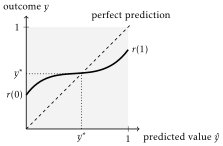
First, draw a point anywhere on the y-axis, representing the realized outcome r(0) when the prediction is \hat y=0. Then, mark a second point on the vertical line \hat y=1, representing the realized outcome r(1). Under the constraint that your pencil may not leave the square, it is impossible to connect the two points without touching the dashed line or lifting the pencil. Thus, for any continuous relationship between y and \hat y, there must be at least one point y^* for which y^* = r(y^*). Thus, y^* comes true after being published.
The standard theory of prediction starts from a fixed distribution {\cal D} over instances of the prediction problem. To talk about performativity, we’ll need to allow the distribution to depend on the predictive model. A distribution map expresses the dependence of the data-generating distribution on the predictive model. Formally, it is a mapping {\cal D}\colon\Theta\to\Delta({\cal X}\times{\cal Y})\,. For every parameter vector \theta\in\Theta, the distribution {\cal D}(\theta)\in\Delta({\cal X}\times{\cal Y}) describes the data-generating distribution that results from deploying—that is, taking action according to—the predictive model f_\theta. Analogous to the idea of a public prediction, we consider a model deployed when it is used across a population to make predictions for multiple individuals.
Consider a couple of examples:
These examples describe two different mechanisms for how performativity can arise in machine learning applications. The distribution map gives a general way to describe how the distribution changes in response to model deployment. The formal setup is general and does not prescribe any specific mechanism behind the distribution map. By instantiating it in different ways, we can capture various aspects of performativity. In each case, the distribution map makes it explicit how the model influences the data-generating distribution.
In practice, a data-generating distribution might change over time for many different reasons. Performative prediction focuses on one and only one source of variation: the effect of model deployment on the data. In particular, the distribution map is stateless, meaning that deploying the same model at any point in time repeatedly leads to the same distribution. The simplicity of this formalism is intentional. It’s the minimal change necessary to talk about model-dependent data-generating distributions.
Given the concept of a distribution map, the next step is to see how the notion changes risk minimization. Recall from Chapter 2 that the risk of a predictor f_\theta on a distribution {\cal D}=(X,Y) is the expected loss R(f_\theta, {\cal D})=\mathop{\mathrm{\mathbb E}}\ell(f_\theta(X),Y)\,. Compared to the risk notation in Chapter 2, we add a distribution argument to the risk functional to make its dependence on the distribution explicit. Rather than evaluating a model on a fixed distribution, now we’ll evaluate the model on the distribution that results from deploying the model: R(f_\theta,{\cal D}(\theta))=\mathop{\mathrm{\mathbb E}}_{(X,Y)\sim {\cal D}(\theta)} \ell(f_\theta(X),Y)\,. As a risk minimization objective, this is a moving target. Suppose you’re currently observing data from a distribution D_0. You solve the optimization problem to find the risk minimizer \theta_1 on the distribution D_0. Once you deploy \theta_1, however, the distribution changes to a new state D_1={\cal D}(\theta_1). And so you continue: D_0\rightarrow \theta_1\rightarrow D_1\rightarrow \theta_2\rightarrow D_2\rightarrow \ldots This process of repeated risk minimization—or retraining—could go on forever, never settling on a fixed point. It might cycle or oscillate. Anything could happen, in principle. However, if the process ever converges, it must be at a fixed point {\theta_{\mathrm{PS}}} that satisfies: {\theta_{\mathrm{PS}}}\in \mathop{\mathrm{\mathrm{argmin}}}_{\theta\in \Theta} \;R(f_\theta, {\cal D}({\theta_{\mathrm{PS}}}))\,. We call any such point {\theta_{\mathrm{PS}}} performatively stable. Performative stability is a natural equilibrium notion that requires the model to look optimal on the distribution it entails. This means that the data collected after deploying {\theta_{\mathrm{PS}}} gives us no empirical reason to deviate from the model. It is optimal on the static risk minimization problem defined by {\cal D}({\theta_{\mathrm{PS}}}). That is not to say that there isn’t some other distribution where models achieve smaller loss. It’s just that on this particular distribution—its “own” distribution—the model is optimal.
Performative stability admits a simple empirical check:
If it is, then we’re at a stable point and the data we see do not refute the optimality of the model. In this sense, an echo chamber is a good metaphor for a stable point: What we experience doesn’t challenge our current beliefs.
Stable points can, in principle, have much larger loss than other solutions. An alternative solution concept therefore asks for the smallest possible risk post deployment globally among all models. More specifically, we say that a predictive model with parameters {\theta_{\mathrm{PO}}} is performatively optimal if it satisfies {\theta_{\mathrm{PO}}}\in \mathop{\mathrm{\mathrm{argmin}}}_{\theta\in \Theta} \;R(f_\theta,{\cal D}(\theta))\,. Performative stability is about optimality in current conditions. Performative optimality is about optimality in future conditions. It’s about anticipating the consequences of model deployment.
We call the risk of a model on the distribution it entails the performative risk, defined as \mathrm{PR}(f_\theta):=R(f_\theta,{\cal D}(\theta))\,. Performatively optimal models minimize performative risk by definition and it always holds that \mathrm{PR}(f_{\theta_{\mathrm{PO}}})\leq \mathrm{PR}(f_{\theta_{\mathrm{PS}}}) for any performative optimum {\theta_{\mathrm{PO}}} and stable point {\theta_{\mathrm{PS}}}. In a static setting the two solution concepts, stability and optimality, both coincide with the classical supervised learning solution. In general, however, performatively stable points need not be optimal and optimal points need not be stable.
In contrast to stability, certifying optimality is harder, as the data available to us need not tell us anything about the performance of any other model post deployment. Moreover, performatively optimal points may be degenerate. For example, it could be that the distribution {\cal D}({\theta_{\mathrm{PO}}}) is a point mass on a single instance where the model has smallest possible loss. Such a solution is performatively optimal, but far from desirable.
Performative prediction changes the rules of prediction. There are now two ways to be good at prediction. To appreciate this point, fix a model \phi that we imagine provides the current data-generating distribution, and consider deploying another model \theta. Observe that the model \theta shows up in two places in the definition of the performative risk: in the first argument, reflecting the dependence of the loss \ell(\theta;\,z) on \theta, and in the second argument representing the dependence of the distribution {\cal D}(\theta) on \theta. Thus, we can decompose the performative risk \mathrm{PR}(f_\theta) as: \mathrm{PR}(f_\theta)=R(f_\theta,{\cal D}(\phi))+ \left(R(f_\theta,{\cal D}(\theta))- R(f_\theta,{\cal D}(\phi))\right)\,. This tautology exposes two ways to achieve small performative risk. One is to optimize well in current conditions, that is, to minimize R(f_\theta,{\cal D}(\phi)). The other is to steer the data to a new distribution {\cal D}(\theta) that permits smaller risk than {\cal D}(\phi). The first mechanism—call it learning—is what machine learning is all about. Learning is the classical way that, for example, a platform can discover and target consumer preferences. Steering is original to performative prediction, allowing the platform to push consumption towards a distribution more favorable to its objectives. This second mechanism, steering, is key to understanding important questions about the impact of predictive models in applications. Due to performativity, model building has a strong normative component, since models can steer populations in different directions.
Performativity is a ubiquitous phenomenon, arising with all predictions that humans act on. The phenomenon has several striking consequences for model evaluation:
The point here is not that evaluation under performativity is futile. Rather, performativity should be one of the fundamental criteria that you apply to predictive systems. It’s a lens on prediction that makes something important visible that’s otherwise easy to overlook from a traditional perspective. In many cases, carefully designed experiments and tools from causal inference can give estimates of performative effects in practice. In other cases, theoretical models can help anticipate performative effects.
Often performativity shows up in practice in the guise of distribution shift. Practitioners deploy a model and later observe that the distribution has changed. The standard solution is to train the model on the data and deploy it again. This process of retraining corresponds to the idea of repeated risk minimization mentioned earlier. Performatively stable points are fixed points of risk minimization. But under what conditions does repeated risk minimization converge to a stable point?
In general, this is a difficult question. We’ll derive an illustrative answer in a simple theoretical model of performative prediction: The marginal distribution X follows a fixed probability measure {\cal D}_X, supported on a bounded domain {\cal X}, that does not change with the predictor. The outcome variable Y, however, does depend on the deployed predictor f via the equation Y = \alpha f^*(X) + \beta f(X)\,. The function f^* represents a stable signal that influences the outcome, but does not depend on the prediction. We think of the coefficient \alpha>0 as the strength of the stable signal. The coefficient \beta is the performative effect, which could be negative. Let the distribution map {\cal D}(f) describe the resulting joint distribution (X,Y). Since we’ll be talking about non-parametric predictors given by a function f, we write the distribution map as a function of f.
Here are two typical examples of a stable signal:
An important restriction of this setting is that the prediction only affects the outcome, not the features. This is called outcome performativity. The example of watch time prediction fits into this setting. Although watch time prediction also influences user and video features in the long run, in the short term its influence is primarily on the target variable.
Starting from some fixed function f_0\colon\mathbb{R}^d\to\mathbb{R}, consider the retraining dynamic defined by the optimization problem: f_{t+1} = \arg\min_{f\colon{\cal X}\to\mathbb{R}}\; \frac12\mathop{\mathrm{\mathbb E}}_{{\cal D}(f_t)} \left(f(X) - Y \right)^2 At each step, we find an unconstrained risk minimizer f_{t+1} on the distribution {\cal D}(f_t) under the squared loss. Under what conditions does repeated risk minimization converge to a performatively stable point?
On a technical note, we always work over the Hilbert space L^2({\cal D}_X) of measurable, square-integrable functions with the inner product \langle f,g\rangle=\mathop{\mathrm{\mathbb E}}_{{\cal D}_X} f(X)g(X) and the associated norm \|f\|=\sqrt{\langle f,f\rangle}. This is a fancy way of saying that you can treat the functions as vectors in an inner product space and do linear algebra with them. Given this inner product, we may always assume that the initial point f_0 is orthogonal to f^* and that both have unit norm. Ensuring so will only affect the coefficients \alpha,\beta.
For \beta=1, the problem is trivial, since f(X)-Y=-\alpha f^*(X) and so the risk does not depend on the predictor. We will therefore always assume \beta\ne1. Since we’re minimizing squared loss, the optimal solution to the unconstrained risk minimization problem for \beta\ne1 gives us the relation: f_{t+1} = \alpha f^* + \beta f_t We take equality to hold pointwise on the domain {\cal X} except on a measure zero set. The update rule has a unique performatively stable point, corresponding to a scaling of the stable signal.
For \beta\ne 1, the objective has a unique performatively stable point f_{\mathrm{PS}}= \frac\alpha{1-\beta}f^*\,. Moreover, f_{\mathrm{PS}} is also performatively optimal.
The claim follows by inspecting the optimal solution and verifying that f_\mathrm{PS} achieves 0 risk.
Given that there exists a unique performatively stable point, will repeated risk minimization converge to it? To answer this question, it will be helpful to analyze the tangent of the angle between two functions f,g, thought of as vectors with the inner product \langle f,g\rangle. The inner product allows us to define the trigonometric functions \tan(f, g) = \frac{\sin(f,g)}{\cos(f,g)}\,, \quad \cos(f, g)= \frac{\langle f, g\rangle}{\|f\|\|g\|}\,, \quad \sin(f, g)= \frac{\sqrt{\|f\|^2\|g\|^2-\langle f,g\rangle^2}}{\|f\|\|g\|}\,. Being a ratio of sine and cosine, the tangent is often convenient to work with. A simple argument gives a geometric—also called linear—convergence rate in terms of the tangent.
Let \beta\ne1. Then, for every t\ge1, \tan(f_t, f^*) = \frac{\beta^t}{\alpha}\cdot\frac{1-\beta}{1-\beta^t}\,. In addition, for |\beta|<1, \|f_t-f_{\mathrm{PS}}\|\to0 at a linear rate as t\to\infty.
The function f_{t+1} lies in the linear span of f_0 and f^*. Recall that we assume f_0 and f^* are orthonormal. For \beta\ne 1, we have f_{t+1}= a_t f^* + b_t f_0 with coefficients: \begin{aligned} a_t &= \alpha \cdot\frac{1-\beta^{t+1}}{1-\beta} \\ b_t &= \beta^{t+1} \end{aligned} Therefore, \tan(f_{t+1}, f^*) = b_t/a_t. For |\beta|<1, we have \lim_{t\to\infty}a_t = \alpha/(1-\beta) and \lim_{t\to\infty}b_t=0. The claim follows.
For |\beta|>1 the coefficients of the solution grow out of bounds. However, when \beta>1, the tangent \tan(f_{t+1},f^*) still converges to (\beta-1)/\alpha. In other words, the angle between the iterate f_t and the stable signal f^* stabilizes at some fixed value.
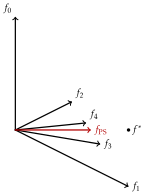
For bounded negative performative effects \beta\in(-1,0), the iterates will oscillate around the stable signal f^* while decreasing the angle with the stable signal.
We can go a step further and achieve convergence for any arbitrarily large performative effect \beta>0. The only thing we need is to add a regularization term to the objective: f_{t+1} = \mathop{\mathrm{\mathrm{argmin}}}_{f\colon{\cal X}\to\mathbb{R}}\; \mathop{\mathrm{\mathbb E}}_{{\cal D}(f_t)}\left[ \left(f(X) - Y \right)^2 + \delta f(X)^2\right]\,. The \ell_2-regularized objective has the optimal solution (for \delta\ne \beta-1) f_{t+1} = \frac{\alpha}{1+\delta} f^* + \frac{\beta}{1+\delta}f_t\,. Provided that we choose \delta > \beta - 1, we have \beta'=\beta/(1+\delta)< 1 and so the previous analysis guarantees convergence to the performatively stable point f_{\mathrm{PS}}=\frac{\alpha}{(1+\delta)(1-\beta')}f^* = \frac{\alpha}{1-\beta+\delta}f^*\,. We can eliminate the regularization parameter \delta by normalizing the function f_t to have unit norm after each update. This leads to the recurrence f_{t+1} = \alpha f^* + \beta \frac{f_t}{\|f_t\|}\,. Any fixed point \bar f of this relation must be collinear with f^* so that \bar f=rf^*. Moreover, we must have r = \alpha+\beta\mathrm{sign}(r). This implies:
Next we show that repeated risk minimization with the normalization step converges to a performatively stable point at a linear rate for any arbitrarily large performative effect \beta\ge0 so long as \alpha>0.
Let \alpha> 0 and \beta\ge 0. For t\ge 1, we have \tan(f_{t+1},f^*) \le \frac\beta\alpha\left(\frac{\beta}{\alpha+\beta}\right)^t\,. Moreover, f_t converges to the performatively stable point (\alpha+\beta)f^*.
Without loss of generality, we may take f^*=\begin{pmatrix}1\\ 0\end{pmatrix} and f_0=\begin{pmatrix}0\\1\end{pmatrix}. By definition, f_1=\begin{pmatrix} \alpha\\ \beta \end{pmatrix}. Therefore \tan(f_1,f^*)=\beta/\alpha. Now, let \frac{f_t}{\|f_t\|}=\begin{pmatrix} a_t\\ b_t \end{pmatrix} so that \tan(f_t, f^*) = \frac{b_t}{a_t}. Then, for t\ge1, we have \tan(f_{t+1}, f^*) = \frac{\beta b_t}{\alpha + \beta a_t} = \frac{\beta a_t}{\alpha + \beta a_t}\cdot \tan(f_t,f^*) \le \frac{\beta}{\alpha + \beta}\cdot \tan(f_t,f^*)\,, since 0< a_t\le1, noting that a_t>0 because \alpha>0. In particular, the argument shows that f_t/\|f_t\| converges to f^*. Therefore, it must be the case that f_t converges to (\alpha+\beta)f^*.
What these results show is that repeated risk minimization can converge even if the performative effect is arbitrarily large. What’s needed, though, is the existence of a stable signal that remains invariant under model deployment. Eventually, repeated risk minimization must settle on the stable signal—as if for lack of alternatives. At least, that’s the lesson here.
Above we considered non-parametric risk minimization, optimizing over all functions. An analogous analysis applies to linear models where f^*(X) = \langle \theta^*,X\rangle and f_t(X)=\langle \theta_t, X\rangle. Provided the marginal distribution on X is isotropic, \mathop{\mathrm{\mathbb E}}XX^T=I, we get the same recurrence relationship in terms of the parameter vectors \theta_t and \theta^*.
Repeated risk minimization is a mathematically precise instance of a data feedback loop. In a data feedback loop, data and model evolve in tandem over time. The model generates, augments, labels, or otherwise modifies a data source. In turn, the data are continually used to train or update the model. Performativity is the key characteristic of all data feedback loops: the data depends on the model.
Chatbots have fueled academic interest in data feedback loops in recent years. If ChatGPT really loves em dashes—and it sure looks like it—we can expect people to use more of them in all their trade books about AI. Trained on those books, newer versions of ChatGPT might then recommend even more em dashes. Soon, em dashes will crowd out all whitespace and punctuation on the internet. Seriously though, language models as chatbots and assistants do create a feedback loop between the model and the data on the internet. There’s been much speculation, and some fear, about what this feedback loop might do.
It’s inherently difficult to experiment with data feedback loops. Performativity is often a phenomenon of scale. It results from applying models with sufficient reach over sufficiently long time horizons. There’s no simple experiment that tells us the long run outcome of a data feedback loop. As a result, researchers have proposed several mathematical models of data feedback loops.
Mathematically, data feedback loops are dynamical systems maintaining a state consisting of data and a model. Both evolve over time according to update rules that depend on the application.
Recommender systems always create a data feedback loop. Engagement signals—such as clicks, likes, or shares—always depend on the model that recommends content to platform users. The most basic feedback loop of algorithmic content curation is that people click on what the platform recommends and platforms recommend what people click on.9 Many scholars have feared that this self-reinforcing feedback loop leads to some kind of content homogenization or collapse in content diversity. Polarization, echo chambers, and filter bubbles are some of the concerns that are often attributed to feedback loops on digital platforms.10 But there are also feedback loops between the platform and the supply side, the content creators.11 Decisions about algorithmic curation create specific incentives for content creators, thus influencing future data.
Feedback loops are also inherent to the digital advertising ecosystem.12 An advertising platform never sees clicks for ads it hasn’t shown, a problem that can partially be addressed with experiments, A/B tests, and causal inference.13 But there are many effects that small-scale randomized experiments can’t anticipate. Suppose a platform experiments with showing three ads, instead of two, on a page in a small randomized experiment. Not knowing about this experiment, advertisers will still bid as if there were only two ads per page. And so the revenue for the platform will likely increase with three ads in the experimental group. Were the change rolled out to the whole platform, the market equilibrium would change. Advertisers will then likely bid lower, reflecting the fact that attention is now split across one more ad, thus diminishing the value of an ad.
Suppose a police department predicts criminal activity in a neighborhood from the number of arrests made in that neighborhood in the last month. Predictive policing is a controversial policy that assigns additional police force based on high predicted criminal activity. Assigning additional officers to a neighborhood, however, will likely result in additional arrests made. The increase in police force therefore also leads to an increase in arrests, which in turn leads to higher predicted criminal activity in the future. Predictive policing therefore creates a positive feedback loop between police force allocation and observed criminal activity.14 This dynamic amplifies initial differences in arrest rates between different neighborhoods. The welfare implication is that some neighborhoods end up being overpoliced and criminalized relative to other neighborhoods. In addition, the self-reinforcing nature of the feedback loop can give proponents of predictive policing a false sense of accuracy of the solution.
The problem isn’t specific to predictive policing. Feedback loops are common in lending, for example. If a bank estimates that a customer has a high default risk, they will assign a higher interest rate to any loan, thereby increasing the financial burden on the borrower. More broadly, research on algorithmic fairness provides different criteria for evaluating the fairness properties of a predictor. The meaning and interpretation of these fairness criteria changes significantly once you take performative effects into account.15
What happens when ChatGPT trains on synthetic data generated by its former selves? In 2023, a group of researchers issued a stark warning: AI models collapse when trained on recursively generated data.16 The proclamation is the upshot of a simple theoretical analysis. Train a generative model on a distribution, generate new data, train another model on that data, and repeat indefinitely. If you take a simple generative model and a diverse initial distribution, the model will forget different parts of the initial distribution and ultimately “collapse” onto one or a few modes of the distribution.
Collapse in this setting is largely a consequence of two factors. First, the model’s limited capacity prevents it from faithfully representing the training distribution. In the more recent data-constrained compute regime (see Chapter 10), where compute resources exceed data resources, it’s less clear that model capacity would be such a strong bottleneck. Second, the model is trained exclusively on synthetically generated data. Mixing in sufficient data from previous iterations turns out to prevent model collapse.17
In a similar vein, we can ask what happens if a model trains on data annotated by the model itself? To lift the capacity constraint on the model, it makes sense to look at what happens for Bayes optimal predictors. Since we’re talking about labeling only, we assume the marginal distribution X is fixed throughout. The initial distribution {\cal D}_0=(X,Y) consists of accurately labeled data.
Consider the following dynamic, repeated for each step t\ge 1:
To make this more concrete, suppose the initial distribution ranges over labeled images. There are images of women wearing scrubs in a hospital environment labeled either nurse or doctor. If the model f_t is an accuracy-maximizing classifier, it will pick the majority label, hypothetically, nurse. This implies that all additional labels will be nurse and the percentage of such images labeled nurse will steadily increase in each iteration. In this case, repeated risk minimization amplifies the initial dataset bias. If the model f_t, however, is Bayes optimal under, say, the cross entropy loss, it will faithfully represent the label proportion of the original distribution. Of course, optimality is not necessary. It’s sufficient for the model to be calibrated in the sense that it preserves the correct label frequencies on average.18
Stories about data feedback loops are interesting and helpful as cautionary tales. They illustrate hypothesized aspects of model deployment in the real world through stylized theoretical models. The worst-case scenarios suggested by some of these dynamical models, however, are likely overblown. Recommendation engines and digital advertising, to give two examples, always operate in data feedback loops. Clicks are model-dependent. It’s a real issue that engineers grapple with. But there isn’t strong evidence for model collapse in recommender systems or the advertising ecosystem. This may in part be due to randomness in the ecosystem.19
Mathematically, the state of dynamical models typically either explodes or collapses as you iterate the dynamics. This is a more complicated version of the basic fact that the exponential a^t either goes to zero or infinity as you grow the exponent t, except in special cases. It’s no surprise to see extreme outcomes of stagnation or collapse in dynamical models. As illustrative models of social processes, dynamical system models are often one-trick ponies. They demonstrate an extreme effect as a kind of cautionary tale.
This much is, in fact, a forgotten lesson of the 1970s, the heyday of the once flourishing discipline of system dynamics. Like the models we’ve just seen, system dynamics modeled social processes as formal dynamical systems. Forecasts and policy recommendations derived from numerical simulations of these systems. The system modelers were ambitious, taking on industrial organizations, urban sprawl, and ultimately the whole world. The most well-known model of the era was World3, a dynamic model of global industrial output, population growth, food production, and climate impacts.20
Although the world may still be on track for its predicted collapse between 2030 and 2050, system dynamics was plagued by numerous problems, scientific validity central among them. In particular, it was difficult to scientifically justify the transitions, weights, initial conditions, and various modeling choices. System modelers instead typically winged it with intuition and confidence. The historian of science Kevin Baker found that system dynamics founder Jay Forrester had, in fact, drawn the precursor to World3 on a queen-sized bed sheet:
Emblazoned on the sheet was an assortment of rectangles, circles, and other shapes, all connected by a chaotic latticework of lines. All these symbols had been hand-drafted in black marker and labeled with the neat, gothic lettering distinctively used by engineers.21
Bed sheets aside, Forrester was known for his disregard for domain expertise that he did not keep a secret.22 Like World3, system dynamics would often show the same qualitative behavior regardless of initial conditions, transitions, or weights. The lack of scientific foundations and unstable dynamics, in turn, led to dubious policy recommendations.23
Where data feedback loops point at vicious cycles, dynamic benchmarks try to create virtuous cycles. The basic idea is simple: Start from an initial dataset, let model builders compete, then add failure cases of the best models to the data pool, and continue. The dataset in a dynamic benchmark is model-dependent, as data and models evolve in tandem. Any dynamic benchmark is therefore, by definition, a data feedback loop. The hope is that as models get better, the benchmark becomes more challenging, thus leading to continual improvement.
In 2021, Meta launched Dynabench,24 a platform to create and host dynamic benchmarks:
We believe the time is ripe to radically rethink the way we do benchmarking. With Dynabench, we can collect human-in-the-loop data dynamically, against the current state-of-the-art, in a way that more accurately measures progress, that cannot saturate and that can automatically fix annotation artifacts and other biases over time.25
Similar ideas also come up in AI safety under the name of red teaming. In red teaming, companies pay data workers to find failure cases of a model. These failure cases are then added in some form to the post-training pipeline.
Do dynamic benchmarks work? Empirical results on Dynabench show that indeed dynamic benchmarks can lead to higher accuracy than a static dataset in some cases.26 But not everyone has been optimistic about the general idea. Researchers Bowman and Dahl caution:
Given a source of examples and a model, adversarial-filtering-style approaches build a benchmark based on samples from that source for which the model fails. Adversarial filtering can remove examples that are easy due to trivial artifacts, but it does not ensure that the resulting dataset supports a valid test of model ability, and it can systematically eliminate coverage of linguistic phenomena or skills that are necessary for the task but already well-solved by the adversary model. This mode-seeking (as opposed to mass covering) behavior by adversarial filtering, if left unchecked, tends to reduce dataset diversity and thus make validity harder to achieve.27
In other words, dynamic benchmarks might lead to the kind of mode collapse we know from data feedback loops. Rather than covering a target domain broadly, dynamic benchmarks might end up putting too much weight on a few modes of the distribution.
To better understand the promise of dynamic benchmarks, it makes sense to first define formally what a dynamic benchmark is and what exactly it’s trying to achieve. The standard dynamic benchmark alternates model building and adversarial data collection. We can generalize this idea a fair bit by allowing a dynamic benchmark to be any directed acyclic graph in which each node represents one of the following operations:
Defining the goal of a dynamic benchmark is a bit subtle. We already assumed that we can invoke model builders that’ll find a risk minimizer up to error \epsilon>0 on any distribution. So, the goal has to be more ambitious. Assume there is a target distribution {\cal D}^* that contains all instances of interest. If we could learn {\cal D}^* perfectly with no error, we’d have a perfect model as far as we’re concerned. Our goal is to set up a dynamic benchmark that produces a sequence of models f_0,f_1,\dots, so that the error of f_t on {\cal D}^* quickly converges to 0 as t grows.
Focusing on binary classification and classification error as the loss function, the standard design of a dynamic benchmark achieves error O(\epsilon^2) after three rounds.
Let f_0,f_1,f_2 be the sequence of models produced by a standard dynamic benchmark with three rounds. Then, the ensemble classifier f = \mathrm{Majority}(f_0, f_1, f_2) achieves error O(\epsilon^2).
Three rounds of dynamic benchmarking can get the error down from \epsilon to \epsilon^2. Unfortunately, in the worst-case this is where things stall.
For any number t > 2 of rounds, there is a problem instance such that the ensemble classifier f = \mathrm{Majority}(f_0 ,..., f_{t-1}) resulting from a t-round standard dynamic benchmark has error at least \Omega(\epsilon^2).
That is, progress in a standard dynamic benchmark can stall after three rounds in the worst case! More delicate designs that use the generality of the definition can guarantee strictly more progress.28 But these benchmark designs may also be hard to implement in practice.
Aimed at a general audience, Jacob Ward’s The Loop gives an excellent account of feedback loops and performativity in digital platforms.29
The framework of performative prediction is due to Perdomo et al., who also gave conditions under which repeated risk minimization converges to a stable point.30 The conditions require the loss to be smooth, strongly convex, and the distribution map to be sufficiently insensitive to changes in model parameters. In particular, this implies that the performative effects are small. For an entry point to performative prediction, see the primer by Hardt and Mendler-Dünner.31 The result on repeated risk minimization in this chapter is from joint work with Jiduan Wu.32
The material about Morgenstern comes from his 1928 habilitation written in German.33 Where I inserted “statistical inference”, Morgenstern wrote “Häufigkeitstheorem” (literally, frequency theorem). This term may have referred to the law of large numbers. My translation emphasizes that Morgenstern broadly criticized statistical methodology rather than any specific convergence theorem. Nearly fifty years later, Morgenstern remarked about his habilitation: “The problems touched in that book never left me.”34
Ensign et al. consider runaway feedback loops in predictive policing.35 Jiang et al. study a model of degenerate feedback loops in recommender systems.36 Cheng et al. study a dynamic model of recommender systems and show how to identify performative effects from exogenous variation without explicit randomization.37 What exactly YouTube’s recommendation model does today is not publicly known. The example of watch time prediction stems from a 2016 Google paper about applying deep learning to YouTube recommendations.38 Turning to home price prediction, Malik and Manzoor ask if machine learning can amplify pricing errors in the housing market.39 There has been much recent work on data feedback loops motivated by large language models.40 The setting of bias amplification in data labeling is due to Taori and Hashimoto.41
Forrester published extensively on system dynamics, notably, the sequence Industrial Dynamics42, Urban Dynamics43, and World Dynamics44, imagining a future of another fifty years of system dynamics in 2007.45 Although largely forgotten by computer scientists, system dynamics was hugely influential. Nobel Prize-winning economist William Nordhaus, for example, published extensively in response to Forrester, proposing a dynamic climate model, called DICE, based on empirical evidence.46 System dynamics also lives on as systems thinking, popular in business and management circles.47 Finally, Will Wright started from Urban Dynamics in 1985 when creating the video game SimCity.
The model and results about dynamic benchmarks are from work by Shirali et al.48
Wald, “Contributions to the Theory of Statistical Estimation and Testing Hypotheses”; Wald, Statistical Decision Functions.↩︎
Neumann and Morgenstern, Theory of Games and Economic Behavior.↩︎
Grunberg and Modigliani, “The Predictability of Social Events”.↩︎
Simon, “Bandwagon and Underdog Effects and the Possibility of Election Predictions”.↩︎
Cheng, Hardt, and Mendler-Dünner, “Causal Inference Out of Control”.↩︎
Jiang et al., “Degenerate Feedback Loops in Recommender Systems”.↩︎
Jagadeesan, Garg, and Steinhardt, “Supply-Side Equilibria in Recommender Systems”.↩︎
Bottou et al., “Counterfactual Reasoning and Learning Systems”; Hwang, Subprime Attention Crisis.↩︎
Bottou et al., “Counterfactual Reasoning and Learning Systems”; Kohavi, Tang, and Xu, Trustworthy Online Controlled Experiments.↩︎
Ensign et al., “Runaway Feedback Loops in Predictive Policing”.↩︎
Shumailov et al., “AI Models Collapse When Trained on Recursively Generated Data”.↩︎
Gerstgrasser et al., “Is Model Collapse Inevitable? Breaking the Curse of Recursion by Accumulating Real and Synthetic Data”.↩︎
Hummel and McAfee, “Machine Learning in an Auction Environment”.↩︎
Baker, “World Processors Computer Modeling, the Limits to Growth, and the Birth of Sustainable Development”.↩︎
Wallace et al., “Analyzing Dynamic Adversarial Training Data in the Limit”.↩︎
Bowman and Dahl, “What Will It Take to Fix Benchmarking in Natural Language Understanding?”↩︎
Shirali, Abebe, and Hardt, “A Theory of Dynamic Benchmarks”.↩︎
Hardt and Wu, “Repeated Risk Minimization Converges to Stable Signals”.↩︎
Morgenstern, “The Collaboration Between Oskar Morgenstern and John von Neumann on the Theory of Games”.↩︎
Ensign et al., “Runaway Feedback Loops in Predictive Policing”.↩︎
Jiang et al., “Degenerate Feedback Loops in Recommender Systems”.↩︎
Cheng, Hardt, and Mendler-Dünner, “Causal Inference Out of Control”.↩︎
Covington, Adams, and Sargin, “Deep Neural Networks for Youtube Recommendations”.↩︎
Malik and Manzoor, “Can Machine Learning Amplify Pricing Errors in Housing Market?”↩︎
Shumailov et al., “AI Models Collapse When Trained on Recursively Generated Data”; Dohmatob et al., “Strong Model Collapse”; Gerstgrasser et al., “Is Model Collapse Inevitable? Breaking the Curse of Recursion by Accumulating Real and Synthetic Data”.↩︎
Shirali, Abebe, and Hardt, “A Theory of Dynamic Benchmarks”.↩︎